
By the million.

More than half a million quantifiable points of impact across thirteen departments this year. Visits, conversations, interventions, programs, late-night spaces held open, barriers removed, students seen. Each one a decision by someone in Student Affairs to show up when it mattered. But, how do you pin down something that you can’t touch and the vast impact it creates? We measure what we can. The numbers are our baseline. But the real work lives in what those numbers represent: A student who persisted through recovery, and saw graduation on the other side. One who didn’t just receive top-quality healthcare, but felt recognized, as a person. Or, someone who met their best friend through a connection that their Resident Advisor set up, because this isn’t just where they stay, it’s where they find a home. Numbers matter because people do. Behind every total is a student who needed something and found it here. And, behind every percentage is a team that showed up immeasurably in the work that we do. Our strategic plan, The GreenPrint, told us where we were headed. This year showed us what it looks like when we actually go there, together, at scale, and with intention. This is the story of that work.
The GreenPrint
We are a model for student-centered excellence and a thriving community where people are proud to work. The successful launch of our division’s strategic plan, The GreenPrint, was designed from the start as a living guide. One year later, that intention has held. The GreenPrint remains our north star, its cascade actively shaping priorities, guiding decisions, and framing the robust work of Student Affairs. Each strategic initiative anchors real priorities, projects that move from page to practice, cross-unit collaborations that align resources and connections that build together under a shared architecture, giving our work both clarity and momentum. This is the difference The GreenPrint has made. It was never created to sit on a shelf or be simply decorative. It drives every piece of what we do, ensuring that the energy of the past year has been purposefully aligned. As we celebrate the milestones of this year, the GreenPrint solidifies our mantra of the Division of Student Affairs that you’ll continue to hear — the architecture of the student experience.
The GreenPrint, embodied
Belonging
Cara Guilbeau
Belonging is the work Cara Guilbeau leads every day at the Carolyn Barber-Pierre Center for Intercultural Life: making sure students do not have to set any part of themselves aside to belong at Tulane. Through programming, advocacy, and partnership across campus, Cara and her team built the conditions in which students can stay whole while they stay here. That is Belonging in practice, not a climate we hope for, but a place students can actually feel because of intentional strategy.
Care
Jay Darr
Care, for Jay Darr, has to be something a student can reach, and a system that answers proactively. New this year as Assistant Vice President for Campus Health and Wellness, Jay joins Tulane from the University of Pittsburgh, where he made counseling easier to find, put clinicians where students live and study, and eliminated waitlists. That’s the bold and thoughtful approach to Care he brings to the GreenPrint: clear pathways, less friction and support that is present before a student has to go looking for it.
Curiosity
Kyle Rice
Curiosity, in Kyle Rice’s work, sounds like the question asked before the next moving piece falls into place. As Director of Housing Operations within Housing & Residence Life, she manages complexity at scale. From the layered, weeklong choreography of something as emotional as move-in, to the systems behind an increasingly dynamic residential experience. Kyle keeps asking what could work better, move smarter, and serve more seamlessly. In the GreenPrint, Curiosity is an open mind with a job to do. She has championed that quality for over a decade.
Respect
Jessica Machado
Respect, in Jessica Machado’s work, is whether a student can enter the classroom, the residence hall, and campus with dignity intact. As Director of the Goldman Center for Student Accessibility, she leads the office whose charge is simple and unfinished: remove barriers so great minds can think differently here, and still belong. That is fairness with a process behind it, and the call that accommodations are not extras. They are how the Division keeps the promise that access is part of the student experience, not an exception to it. Jessica’s work makes Respect concrete: dignity as the default, inclusion as design, and the continued pursuit of not doing just what’s good enough, but building an extraordinary experience for all.
Integrity
Erica Woodley
Integrity is the value students test when the moment is not easy. Erica Woodley meets that head on as Associate Vice President and Dean of Students: where accountability and care have to hold equally in the same space. Her work is consistent, principled decision-making when a student is off track, when a family is in crisis or when the community needs a clear standard. Trust is built by applying the same principles on the hard days as on the easy ones, and by telling the truth about both. That is the Integrity the GreenPrint names, and the standard her teams lead by.







The teams behind the work
The teams behind the work. Thirteen departments. Hundreds of people. Over a thousand student employees. More than half a million points of contact this year through visits, conversations, interventions, programs, late-night spaces held open and barriers quietly removed. Each one a decision by someone who chose to show up when it mattered. Each one an act of caring out loud, inspired by the brilliance of the students who shape this community.
Department Teams Led By:
Erica Woodley - Associate Vice President, Dean of Students
Laura Osteen - Assistant Vice President, Campus Life
Jay Darr - Assistant Vice President for Campus Health and Wellness
Alan Clerk - Assistant Dean, Finance & Operations
A phenomenal student experience
Fraternity & Sorority Programs: Nearly 40 percent of undergraduates live inside the Greek community, and the office spent the year raising what that belonging requires. The inaugural W.A.V.E. Awards drew more than 100 people, while two assistant directors brought home first place in an international program-design competition. Not to mention, all of it happened while the office actively recruited for various positions over the course of three-quarters of the year.
Housing & Residence Life: The buildings expanded; and the culture had to follow. Resident Advisors shifted toward presence, prioritizing floor meetings, more than 10,000 Wave Chat conversations, and a Campus Cup that drew 1,100 new students into community in the first week. Longer stays required deep connection, and HRL gave every student in on-campus residence life a community that nurtured that space.
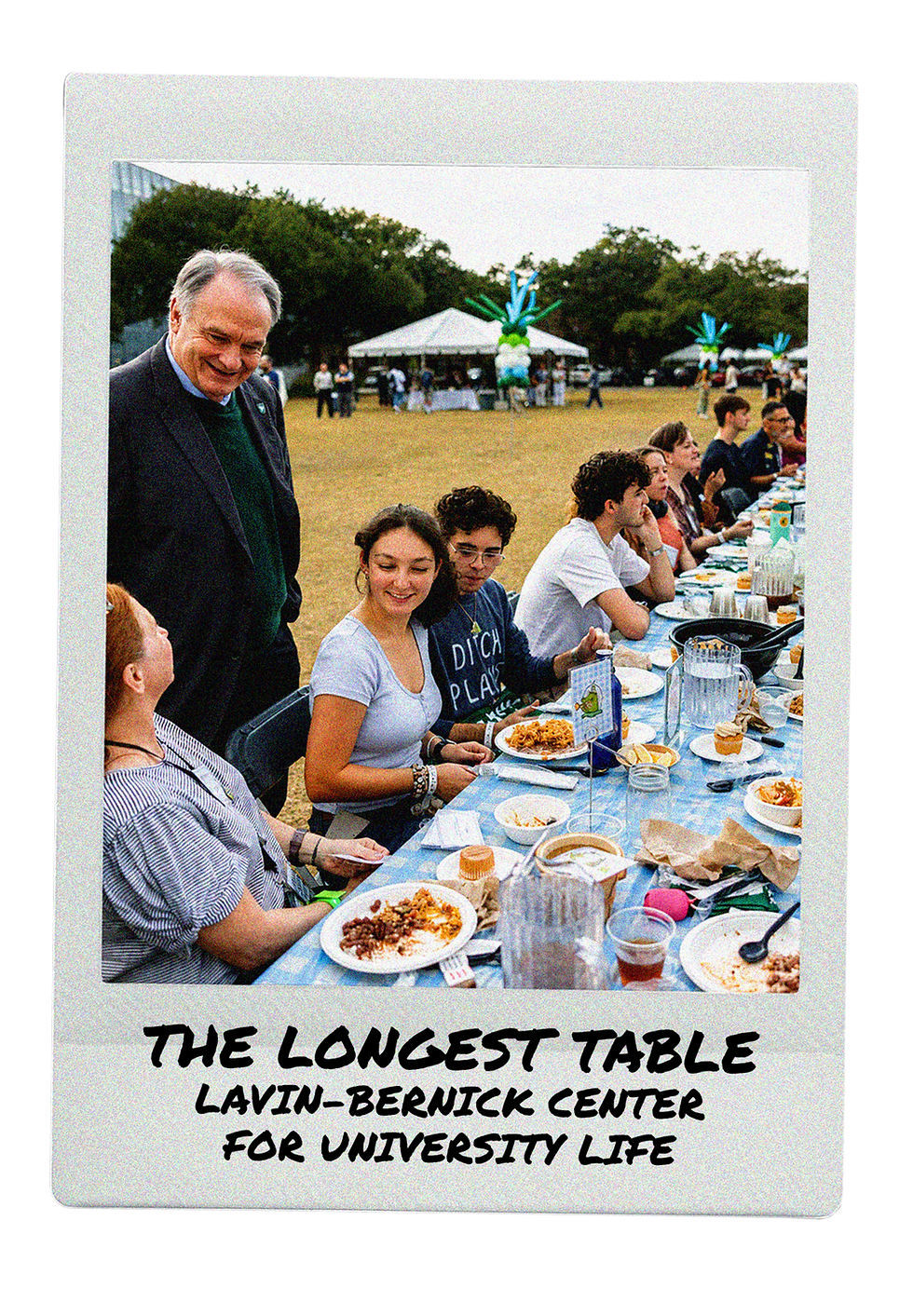
The Lavin-Bernick Center for University Life: The Rathskeller Lounge (The Rat) finished its first full year and programming more than doubled, turning one renovated space into the clearest proof that the building could function as a platform for engagement rather than a shell. Across the year the LBC supported 8,098 reservations, recorded more than 1.1 million building entries, and helped host events that drew an estimated 475,402 attendees; showing how scale arrived without erasing the human texture of student life.
Bradley Leadership Educator in Residence Program: Leadership became something to practice, not simply study. Through the Bradley Leadership Educator in Residence Program, Tulane welcomed Dr. Vivechkanad Chunoo for a week of workshops, conversations and hands-on learning exploring culturally relevant and ethical leadership. Students, faculty and staff were invited to think differently about community, failure, integrity and their own capacity to create change, turning leadership theory into something lived.
The Carolyn Barber-Pierre Center for Intercultural Life (CBP-CIL): CBP-CIL continued the work of making belonging tangible this year, while also welcoming new staff to strengthen the team and expand its reach. During the Fall 2025 semester, the Center recorded 761 student engagements, and Center-advised student organizations hosted nearly a thousand students across their event offerings. Through programming, advocacy, and steady partnership across campus, the Center created conditions in which students do not have to set aside parts of their identity to participate fully in university life. Its contributions reinforced the Division’s core values, belonging, care, respect, and curiosity, helping ensure students can remain whole while they remain here.
August Martin, Jr. (SSE ’93, SPHTM ’00) was proudly celebrated as this year’s CBP-CIL Cornerstone Award recipient. A two-time Tulane graduate, sustainability leader, founder of Treme Impact Strategies and President-Elect of the Tulane Alumni Association Board of Directors, August has spent decades investing in the community that first invested in him. His leadership, advocacy and enduring commitment to students embody the spirit of the award: a legacy built not in a single moment, but through a lifetime of showing up.
And from CBP-CIL Intern, Mason Mitchell:
"This internship has given me more than work experience, it has helped me think about what it means to prepare for my future career and learn from people who genuinely care about my growth. Dr. Cara Guilbeau and Mr. Carl Thomas have been more than supervisors; they have been mentors who have supported and encouraged me along the way."
Campus Recreation: The Campus Recreation team rebuilt the model, adjusting memberships, reopening the community, and pioneering an emphasis on not just a healthy student body, but a staff rooted in wellness too. Facility rental revenue nearly doubled from $13,982 to $27,772 and clocked roughly $250,000 in new revenue. At the same time the Reily Center recorded 450,058 visits, TU Fit added 48,355 more, and 61.2 percent of students engaged with a program or facility, while main gym usage climbed 91.7 percent.
Campus Health: The work stayed upstream. Efforts like the influenza campaign and expanded free STI screening pushed preventive care farther across both campuses, while closer collaboration with Counseling and Psychiatric Services improved coordination for students whose medical and mental health needs refused to stay in separate lanes. All this while patient satisfaction averaged an impressive 96 percent, showing not only the measure of care, but the impact of students’ feeling seen.
The Well for Health Promotion: Prevention only matters if someone measures whether it is working. The Well built that discipline; New evaluation frameworks, clearer referral pathways, and a BASICS alcohol intervention that saw cases rise from 21 to 61 and completions from 11 to 41. Staff added specialized capacity and restructured student-organization advising for stronger mentorship, all with care at the focal point of their work.
Counseling & Psychiatric Services: Students kept saying they felt respected and understood with over 95 percent reporting satisfaction with the care they received. Behind that number, CAPS rebuilt access itself: teletherapy utilization of the prior model dropped 41 percent after new options expanded, and the BridgeCare coordination pathway guided more than 150 students through referrals, insurance, and the difficult space between campus and community providers. The year closed the distance between the promise of help and the actual experience of receiving it.
Tulane Recovery Community: This year TRC made recovery impossible to overlook. The community delivered 145 recovery support meetings, supplied more than 1,000 doses of naloxone for campus-wide distribution through HEART, and trained over 50 Tulane EMS members in Recovery Allyship, 96 percent of whom left saying they better understood what it means to stand with a student in recovery. With the addition of its first funded MSW intern, TRC expanded both its reach and its capacity, turning daily support, overdose prevention, and campus education into measurable infrastructure for students whose success depends on staying in recovery while staying in school. from Nick Harrison, "I had heard about the Tulane Recovery Community (TRC) and reached out to the Director of Recovery Programs. Meeting with Jacob Goldberg and attending the TRC meeting were prominent factors in my choosing Tulane University over Columbia University. As a disabled, non-traditional, first-generation college student navigating upward mobility, this mentorship has been transformative. Jacob has literally changed my life."
Case Management & Victim Support Services (CMVSS): CMVSS focused this year on meeting students where basic needs and support intersect. The Personal Pantry distributed 106 bags of essentials, with downtown distribution rising 300 percent as the office responded to clear demand among graduate and professional students, 43 percent of 1,092 cases in that population referenced food or basic-needs support. At the same time, two staff members were promoted into leadership roles, deepening continuity and capacity across the team. What began as direct student support grew into a clearer, more responsive system for catching students earlier and keeping them connected to the resources that help them stay.
Family Programs: Twenty-four webinars reached more than 6,000 viewers, while the newsletter held an open rate near 80 percent among first-year families. A tailored communication track for TU Thrive families began taking shape, recognizing that first-generation and limited-income students succeed in part because the adults who support them are not left guessing. The contribution was quiet and structural: keeping the people who love Tulane students informed and close.
Goldman Center for Student Accessibility: Demand climbed without pause—2,349 active students, 1,477 navigating multiple disability categories, more than 16,200 accommodated testing requests—and Goldman built capacity as fast as the need arrived. Key positions were filled, Standards of Practice written into daily work, housing processes redesigned, and the systems tracking it all improved. At the same time the office pushed training and consultation outward so accessibility could be addressed earlier across campus rather than only remediated later.
Student Conduct: Accountability became faster and more developmental this year. A redesigned noncompliance process shortened overall ajudication timelines by over 75 percent, so students could complete sanctions and the learning that comes with them much closer to the original incident. Collaboration with Housing strengthened case flow and support for hearing officers, while a new two-tier bias-tagging system improved ability to track and understand discrimination-related cases. The result was a clearer, more responsive system that kept fairness and student growth at the center of every process.
Deep Impact
Campus Recreation reached more than 60% of the Tulane student population with over 450k visits to the Reily Student Recreation Center
The Division of Student Affairs hosted our first ever Graduate and Professional Students Welcome Reception at the Glazer Family Club
Student Conduct cut the adjudication process down by over 75% - meaning a better, more efficient, experience
Case Management and Victim Support Services sustained more than 5,000 individualized support cases
Resident Advisors on our Housing and Residence Life team created more than 10,000 student opportunities for personal connection
The Goldman Center for Student Accessibility handled over 16,000 testing accommodations, while also serving nearly 3,000 active students
Counseling and Psychological Services earned a 95% student satisfaction rating for quality of care, making our students feel seen and prioritized
Tulane’s Recovery Community celebrated 9 incredible students who persisted on their recovery journey to successful graduation completion
Over 96% of students were personally satisfied with the level of care they received from our Campus Health team - delivering a high standard of care
The Division of Student Affairs is home to 386 Registered Student Organizations, and growing
The numbers tell part of the story. The moments tell the rest. Over the past year, Student Affairs created the experiences that shape a Tulane student’s sense of belonging, care, and possibility. The real measure of our year is not only what we counted, but what students felt, carried, and became.


Looking for more? Connect with us or request to receive a print copy of the 2026 Annual report.